| |
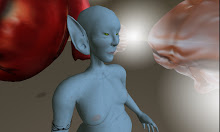
| One Heart, Four Brains Installation in Second Life
The Avatar Orchestra Metaverse was invited a few weeks ago by Franziska Schroeder to participate in a collaborative performance with the Australian performance artist Stelarc. This mixed reality performance will take place at the Digital Resources for the Humanities and the Arts Conference at Brunel University in the UK on September 5, 2010, with the Orchestra projected from Second Life.
Stelarc's views are compelling and provocative. "The body is obsolete", spoken by a Stelarc-voice robot in various realities and performances, has been running through my head as we work out the details of the collaboration.
Today, I watched a video of a TED talk by Aimee Mullins, a young woman with an amazing spirit, and without biological lower legs. Like Stelarc, she talks about how altered we already are, with replaced hips, eyeglasses, hearing aids, blood transfusions, enhanced breasts and lips. We are already hybrids, we are already part machine, part biology. "The only disability is a crushed spirit", says Aimee.
Stelarc has used, tested, experimented with and enhanced his physical body in so many ways. He has fused it with mechanical and organic devices. I find myself wondering what is physical about working in the virtual world, without a clear and direct physical sense of presence or connection to the living body in the intention of the practice. The Avatar Orchestra tends toward a cerebral focus. Mental tele-presence, with resulting beautiful yet elusive worlds. Disembodied.
One Heart, Four Brains Installation with particle emissions (particles by Bingo Onomatopeia)
How is it that we feel our real hearts beating while playing with virtual sounds and images? Does our heart change from this work, this experiment? Does our skin change, do our eyes change, does our brain change?
Pauline Oliveros, also involved in this collaboration, maintains that yes, our brains are evolving and changing rapidly with our use of technology. I agree with her. I also believe that there is no such thing as a distinction between "natural" and "synthetic". Unless we have been beamed in from some other planet, some other world, it is true to say that machines come from the same place we do, the same place radishes and granite and gray wolves do. And our creations are changing us. |
Showing posts with label Avatar Orchestra Metaverse. Show all posts
Showing posts with label Avatar Orchestra Metaverse. Show all posts
Friday, 6 August 2010
Is the body obsolete? Pondering AOM's Stelarc Collaboration


Monday, 5 April 2010
Making Music in a Virtual Biomass Just Feels Good
April 5, 2010
New media. Media art. Virtual art. Virtual reality. Virtual Performance Art. Networked Reality. Nanotechnology. Cyborg. Hybrid ...

I don't know where all of these terms and the realities they refer to are going, how the theory of networked reality art relates to what I am doing. What I do know is that composing, collaborating and performing in the virtual reality world of Second Life, in communion with the other beings I work with, brings forth a deeply compelling music that I certainly would not experience otherwise. It surprises me.
And I am not talking about the musics that are translated from this visceral here and now life into the virtual world. There are many examples of these. I mean the music that has been created within that world, taking in that experience and way of connecting and that has informed the creators from a place of deep curiosity and newness in this new environment.
I know that the virtual instruments that have been created collaboratively for my compositions in Second Life would not have been conceived outside of that world. The concepts may have been, the sound world of two harmonic series juxtaposed of course is a simple idea that has been much explored. Electronic pieces could be created exploring the beat patterns, difference and combination tones, exploring the just intoned intervals between the two series, the musicality of electric motors placed in this context ... all of this is possible and has been done.
But the communion of the individuals linked together in the virtual world, breathing together, seeing the replications of each others' presence, making their own choices because of how they are listening together to these particular instruments in this visual space together ... this experience could not be reached in a composer-created electronic piece ... nor could it be created in a visceral here and now group performance of the same sound material.
What compels me about composing and sharing music in this virtual world is the unique yet familiar attractiveness of the music making - it "feels good" to do it, and it feels good to listen to it. And it is not a kind of music that I can participate in in any other way that I know of ... at the moment.
This is good enough for me. I don't need a theoretical framework, a conceptually orgasmic context, the camaraderie of academe. It just sounds good, it feels good, it compels deeper listening, feeling and thinking, and connects people to one another in sound and perception in a good way. I really cannot explain it and I cannot ask for more.
New media. Media art. Virtual art. Virtual reality. Virtual Performance Art. Networked Reality. Nanotechnology. Cyborg. Hybrid ...

I don't know where all of these terms and the realities they refer to are going, how the theory of networked reality art relates to what I am doing. What I do know is that composing, collaborating and performing in the virtual reality world of Second Life, in communion with the other beings I work with, brings forth a deeply compelling music that I certainly would not experience otherwise. It surprises me.
And I am not talking about the musics that are translated from this visceral here and now life into the virtual world. There are many examples of these. I mean the music that has been created within that world, taking in that experience and way of connecting and that has informed the creators from a place of deep curiosity and newness in this new environment.
I know that the virtual instruments that have been created collaboratively for my compositions in Second Life would not have been conceived outside of that world. The concepts may have been, the sound world of two harmonic series juxtaposed of course is a simple idea that has been much explored. Electronic pieces could be created exploring the beat patterns, difference and combination tones, exploring the just intoned intervals between the two series, the musicality of electric motors placed in this context ... all of this is possible and has been done.
But the communion of the individuals linked together in the virtual world, breathing together, seeing the replications of each others' presence, making their own choices because of how they are listening together to these particular instruments in this visual space together ... this experience could not be reached in a composer-created electronic piece ... nor could it be created in a visceral here and now group performance of the same sound material.
What compels me about composing and sharing music in this virtual world is the unique yet familiar attractiveness of the music making - it "feels good" to do it, and it feels good to listen to it. And it is not a kind of music that I can participate in in any other way that I know of ... at the moment.
This is good enough for me. I don't need a theoretical framework, a conceptually orgasmic context, the camaraderie of academe. It just sounds good, it feels good, it compels deeper listening, feeling and thinking, and connects people to one another in sound and perception in a good way. I really cannot explain it and I cannot ask for more.
Saturday, 2 January 2010
Aural Plasma in a Virtual World
April 10, 2009
Aural Plasma.
Much of the time, in most circumstances, I close my eyes when I play and perform music. The removal of the visual gives a focus on the aural. It gives a kind of permission that pulls me in to a comfortable place where I can be, do and act. A familiar kind of sonic plasma feeds and guides my senses and responses and slows down time. Closing my eyes helps me to experience synchronicity with this place quickly and directly. Sometimes, in some situations, visual cues are necessary ... and I have become more adept at remaining immersed and in tune with aural plasma while also having my eyes open. In these cases I find my eyes might close for 'power on' moments to keep the umbilical cord connection to the deeply aural. My fingers, hands, arms, breath, movements, vocal chords ... and whatever instrument, object that I am resonating ... all of this together is a sonic extension of my blind connection to the plasma of that aural world.
This aural world is one I am intimate with and feel at home in. It gives me access to a multi-faceted attention state that is encompassing, global, temporal, detailed, energizing, hi-fi. Those of us who have had the pleasure of working in aural tradition over a lifetime are perhaps less visually oriented than others. Perhaps our sense of the temporal has different nuances. I am not sure about this. Maybe it is one way to think about it for now.
I have been thinking about the many aural traditions of music-making and their possible relationship to what we are doing in the visually focused world of Second Life.
After playing in Second Life for about 16 months, I could manage sometimes to get to that deep aural plasma ... moments when my virtual sonic responses were relatively in sync with the shifted temporal space that I can experience in good moments of playing in a non-virtual situation. It's a narrower world for me yet, but perhaps that is a judgment to think about.
With virtual instruments such that the Avatar Orchestra uses, we performers of sound mostly use the mouse to click on specific control areas on our computer screens to determine the sounds we are making in real time. Just the mouse held in one hand, moving the cursor over screen areas. The other hand operates at times the arrow buttons to move the avatar to disperse the sound in the space.
Sometimes I can close my eyes for very brief moments, but closing my eyes seems counter-intuitive to being present in this virtual reality world ... maybe. I realize I am searching for that aural comfort zone, and that I will have to allow it to stretch its definition, find a new neural pathway in my brain so it can connect with what is present in this virtual world.
I am not yet getting a sense of a distinct feel for the physical connection to each sound I make, or to the distinct sounds that others make, like I can experience with instruments and other players in non-virtual situations.
I still need to keep my eyes open to play the virtual instrument controls on my screen, to move my avatar to distribute the sound within the virtual environment, and to keep my avatar from falling off a platform, or colliding with another performer or object. But if it is possible to become familiar enough with the homogeneous keys of a piano or accordion, I think there might be just a bigger shift needed to mind-map a way to find a link between the mind, the computer screen in such a way that I can find that encompassing, temporally altered acoustic plasma space, only in an audio-visual sense - perhaps with developing interfaces not unlike a more sophisticated Wii.
Mind stretching in tendrils out past blood, bone, muscle skin to other worlds in sound. Ha.
Aural Plasma.

Much of the time, in most circumstances, I close my eyes when I play and perform music. The removal of the visual gives a focus on the aural. It gives a kind of permission that pulls me in to a comfortable place where I can be, do and act. A familiar kind of sonic plasma feeds and guides my senses and responses and slows down time. Closing my eyes helps me to experience synchronicity with this place quickly and directly. Sometimes, in some situations, visual cues are necessary ... and I have become more adept at remaining immersed and in tune with aural plasma while also having my eyes open. In these cases I find my eyes might close for 'power on' moments to keep the umbilical cord connection to the deeply aural. My fingers, hands, arms, breath, movements, vocal chords ... and whatever instrument, object that I am resonating ... all of this together is a sonic extension of my blind connection to the plasma of that aural world.
This aural world is one I am intimate with and feel at home in. It gives me access to a multi-faceted attention state that is encompassing, global, temporal, detailed, energizing, hi-fi. Those of us who have had the pleasure of working in aural tradition over a lifetime are perhaps less visually oriented than others. Perhaps our sense of the temporal has different nuances. I am not sure about this. Maybe it is one way to think about it for now.
I have been thinking about the many aural traditions of music-making and their possible relationship to what we are doing in the visually focused world of Second Life.
After playing in Second Life for about 16 months, I could manage sometimes to get to that deep aural plasma ... moments when my virtual sonic responses were relatively in sync with the shifted temporal space that I can experience in good moments of playing in a non-virtual situation. It's a narrower world for me yet, but perhaps that is a judgment to think about.
With virtual instruments such that the Avatar Orchestra uses, we performers of sound mostly use the mouse to click on specific control areas on our computer screens to determine the sounds we are making in real time. Just the mouse held in one hand, moving the cursor over screen areas. The other hand operates at times the arrow buttons to move the avatar to disperse the sound in the space.
Sometimes I can close my eyes for very brief moments, but closing my eyes seems counter-intuitive to being present in this virtual reality world ... maybe. I realize I am searching for that aural comfort zone, and that I will have to allow it to stretch its definition, find a new neural pathway in my brain so it can connect with what is present in this virtual world.
I am not yet getting a sense of a distinct feel for the physical connection to each sound I make, or to the distinct sounds that others make, like I can experience with instruments and other players in non-virtual situations.
I still need to keep my eyes open to play the virtual instrument controls on my screen, to move my avatar to distribute the sound within the virtual environment, and to keep my avatar from falling off a platform, or colliding with another performer or object. But if it is possible to become familiar enough with the homogeneous keys of a piano or accordion, I think there might be just a bigger shift needed to mind-map a way to find a link between the mind, the computer screen in such a way that I can find that encompassing, temporally altered acoustic plasma space, only in an audio-visual sense - perhaps with developing interfaces not unlike a more sophisticated Wii.
Mind stretching in tendrils out past blood, bone, muscle skin to other worlds in sound. Ha.
Subscribe to:
Posts (Atom)